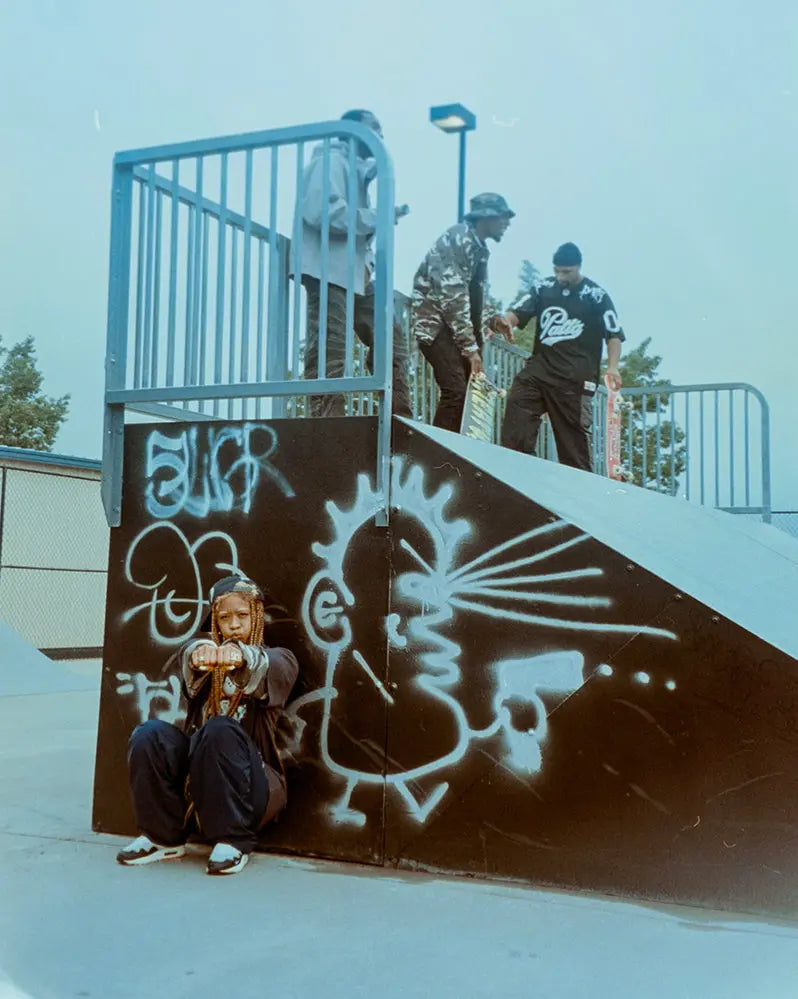
TiaCorine for Patta Magazine
TiaCorine for Patta Magazine
Words: Christopher DanforthOn August 5, TiaCorine released the video for "HOOPTY," from Strictly 4 the Scythe, the debut album from Denzel Curry-led hip-hop collective The Scythe. The following afternoon, I catch up with her over the phone while she's driving to a nail appointment."What does a typical day look like for you right now?" I ask."I pick up my daughter, go to the gym," she says. Beyond music, staying connected with the community she's built has become part of her daily routine. "I'll talk to my Discord. Tuesdays, Fridays, and Sundays are my stream days."One aspect that is surely evident to anyone discovering Corine - she brings together a mix of influences that isn't really represented by her musical peers: North Carolina rap, Indigenous spirituality, anime, Japanese fashion, internet culture, and Southern hip-hop all coexist inside her work. That instinct is evident on "HOOPTY," where even alongside artists like Denzel Curry and Smino, her creative presence is very much there.The group’s first album is centered around Southern hip-hop, with stylistic references spanning from Memphis to Miami. Despite each member of The Scythe bringing a distinct identity to the table, Tia describes the group's chemistry by saying, "It's weird because we can criticize each other without anyone getting emotional. Denzel and I have yelled and screamed at each other before. We've literally wrestled before, but it's out of love, though. So it's kind of like a wolf pack. Wolves bite each other, but it's all love."Many of the relationships within the group - officially consisting of Denzel Curry, FERG (previously known as A$AP Ferg), Bktherula, Key Nyata, and TiaCorine - had existed for years before The Scythe came together. "I think everybody had preexisting relationships and then it just all melted together," she says, noting that she had known collaborator Bktherula since she was 16 years old.According to Corine, Denzel Curry was the person who turned those individual friendships into a bigger idea. "Denzel definitely brought us together. He brought everybody together and made it clear that we all stand on our own, but let's make a supergroup. We're more powerful together."For the group’s "HOOPTY" video, Corine’s mother styled her black ensemble.When I was little, she taught me how to sew. When I got a little bit more money and stuff, I decided to retire her so that she could sew and spend her time doing whatever she loved to do. Now I just give her little projects because she wants to expand her sewing skills.""My mom, she was just always very open. She always allowed me to try anything that I ever wanted. She always left it up to me to choose what I wanted to do. I feel like that's why it's hard to put me in a box. She put me in ballet. And then a week later I'm like, 'Oh, I want to try baseball.' And so she allowed me to try anything that I ever wanted."That openness extended beyond creativity. It also shaped a distinctly spiritual worldview that Corine expresses. "As a kid, I would get déjà vu a lot. And I would talk to my mom about it. She would just say, 'That's just a part of us.'""I'm not really from North Carolina... I'm from outer space somewhere."It's a line that makes me laugh at first, but it also captures something about how she sees herself. North Carolina is part of her story, yet she also seems to resist definitions in all forms. Born to a Shoshone indigenous mother and a Japanese-African father, she sees herself as the product of many different influences."There are so many different parts of me, and that's how I know that I don't want to simplify myself." Reinvention, she says, isn't about abandoning who you are - it's about finding new ways to express the same core identity. "I don't like to stay on something for too long. Because I'm forever changing. It's important to reinvent yourself. I change, but I remain who I am."When she's looking for a metaphor, she reaches for an unlikely source, but one that clearly shows her love of Japanese anime and culture. "I relate to Kirby a lot because Kirby can eat anything. He might eat a chef, but he's still Kirby."But standing apart like that can have its drawbacks. "Sometimes I think it hurts me because it's so unique that it's unfamiliar. So it's like a blessing and a curse. I do pride myself in the fact that my stuff is unique and I always wanted to stay that way." Corine feels that in some cases, she needs to win people over with an attitude that some, including Corine herself, might describe as “freaky.” In addition to her hit track “Freaky T,” Corine recently brought “Freaky” Hot Dogs topped with chilli, nacho cheese, and onions to a recent event in her birthplace of Winston-Salem, North Carolina. “Freaky is fun. It's fun. It's flirty. It's experimental. A lot of people think women are supposed to be submissive, so I think it's kind of like the woman taking the power back.” "I love hot dogs. After the club, I'm getting a hot dog, bro."Whether you catch her serving hot dogs in Winston-Salem or talking to her on her Discord, Corine seems just as interested in building a community as she is in making music. The Discord server itself came directly from her fans."My fans would say, 'Hey, you need to get a Discord.' And I was like, 'Okay.' So I listened to them, and I got a Discord. Then I would tease projects, or I ask them a question like, 'Hey, what y'all think about this song?'""I'll have times where we can get on a video chat. Everybody will roll up, and we'll talk early in the morning, and I'll just tell them about my life, what I have going on."That sense of community even carried her through heartbreak, so I just picked up the game to distract myself. And all my friends squad up on Fortnite. Once I got better, I started adding fans to my Xbox, and they just would start playing with me."Maybe Corine really is from outer space; I guess in a cosmic sense, we’re all made from stardust, but that’s a digression. What defines Corine is not where she’s from. She is from North Carolina, from Japan, from the internet, from hip-hop, from anime, from everywhere and nowhere all at once. More importantly, she's able to move between those spaces without losing herself. Not only does that creative freedom help define her music - it's what makes her feel like she's from the world.Get familiar! Patta Magazine Volume 7 available now at Patta Amsterdam and Patta London.